
Yearly Archives: 2021

/2021
­

Cordoba, the Jewish Quarter

The Jewish quarter of Cordoba is an area of the Spanish city of Cordoba that was, between the 13th and 15th centuries, the neighborhood in which the Jews lived.
The area that is currently known by that name is located northwest of the Mosque-Cathedral.
It is part of the historic center of Córdoba that was declared a World Heritage Site by Unesco in 1994.
It is one of the most visited areas by tourists since, in addition to the Mosque-Cathedral, you can see monuments such as the Synagogue, the Municipal Souk or the Mudejar Chapel of San Bartolomé, as well as museums such as the Casa de Sefarad.
Although there is evidence that there was a Jewish presence in Córdoba since Roman times, the Jewish quarter of Córdoba has not always been located in the same place.
In fact, after the Muslim invasion, the Jews were expelled outside the walls, mainly in the north, between the gardens of La Merced and the church of Santa Marina.
The only Jewish tombstone found in the city, referring to Yehudá bar Akon, dated in the year 845, was found from this time in the neighborhood of Zumbacón; as well as the funerary square inside the church of San Miguel, which show the presence of a Jewish necropolis in the area.
The destruction of this first Jewish quarter came after the fall of the Cordovan Caliphate and the sacking of the city at the hands of Suleiman in 1013, for which many Hebrew families were forced into exile. However, the definitive repression and annihilation took place with the arrival of the Almohads in 1148, Berber radicals from North Africa, who prohibited the Jewish presence in the region.
After Fernando III recovered the city during the conquest of Córdoba in 1236, the Jews returned to settle there, while his son Alfonso X the Wise closed and delimited the Jewish quarter in 1272, in the northwestern area of the Mosque-cathedral , as it is currently known.
In 1315 what is probably the most representative building of the Jewish quarter was built: the Synagogue of Cordoba, made by the architect Isaac Moheb.
Cordoba lived a splendorous time when three peoples (Christian, Jewish and Muslim) with their corresponding religions coexisted, although not peacefully since the expeditions of punishment of the emirs and caliphs towards the suburbs where the non-Muslim population was located were periodic.
In the street of the Jews we now find a bronze statue dedicated to Maimonides, the great Jewish philosopher and doctor from Cordoba, whose family was forced to convert to Islam and in the end he himself had to leave the city during the Almohad persecution.
During the 10th century, Cordoba was, after Byzantium, the largest economic and cultural center in Europe, and although the Muslim, Jewish and Christian population coexisted in the city, this coexistence was far from peaceful.
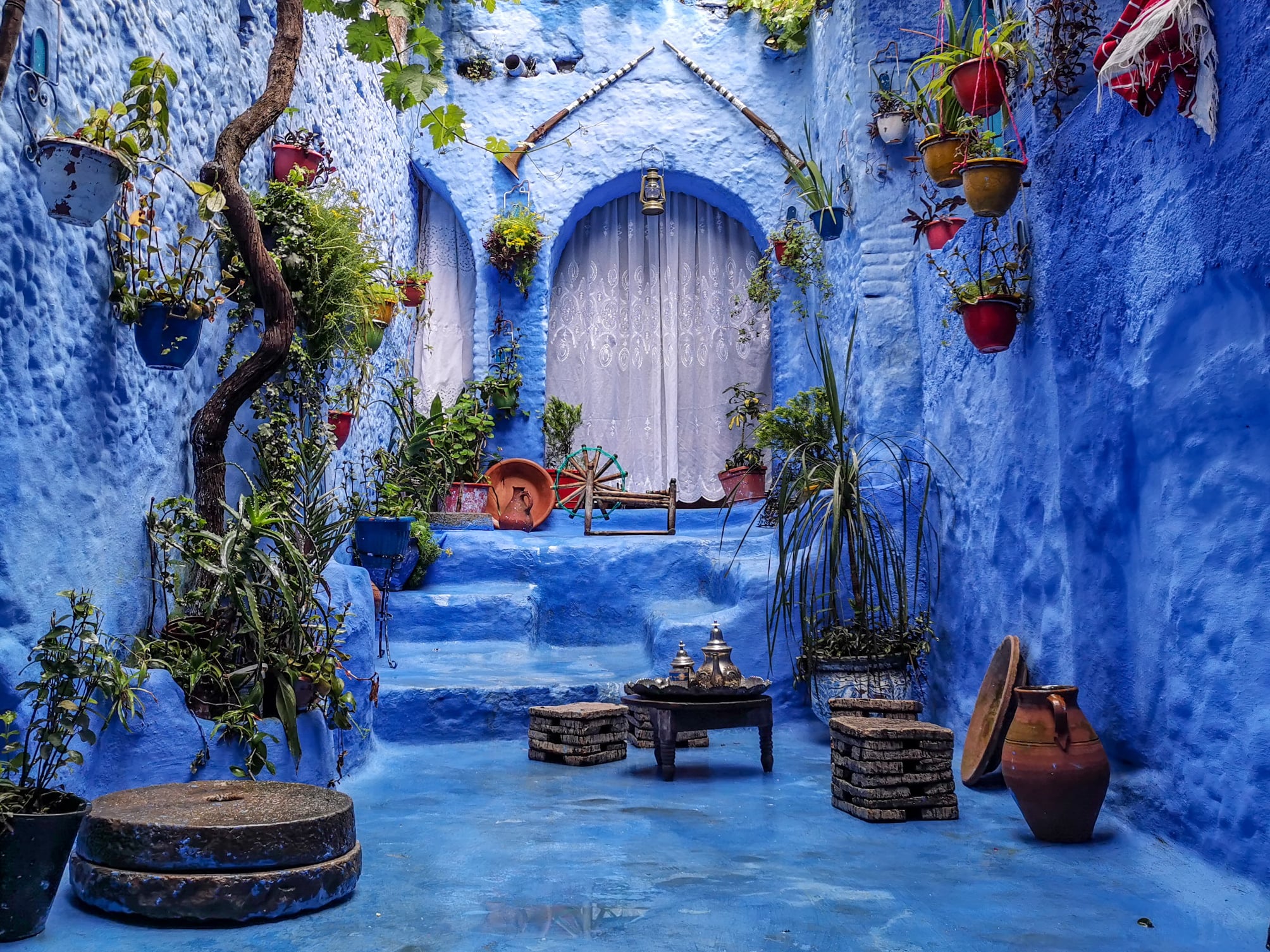
Chefchaouen, the blue city

Chefchaouen in  Morocco is often called the blue city or the blue pearl.
In the north of Morocco, in one of the most beautiful places in the Rif mountains, this city of narrow streets and houses painted white and blue emerges. Indigo stains the streets of the medina of the city of Chefchaouen.
The city was founded in 1471 on the site of a small Berber population. Its original population consisted mainly of exiles from Al-Andalus, both Muslims and Jews, which is why the old part of the city has an appearance very similar to that of the Andalusian towns, with small streets of irregular layout and whitewashed houses.
The city was founded as a small kasbah (fortress) by Moulay Ali ibn Rashid al-Alami, a descendant of Abd as-Salam al-Alami and Idris I, and through them, of the Islamic prophet Muhammad. Al-Alami founded the city to fight the Portuguese invasions of northern Morocco.
Along with the Ghomara tribes of the region, many Moriscos and Jews settled here after the Spanish Reconquista in medieval times.
After eight years of the creation of the Spanish Protectorate in Morocco the Spanish Army could effectively take Chaouen, when General Dámaso Berenguer occupied the city on 14 October 1920.
Following the 1924 retreat of the Spanish army from the city  Chaouen was part of the Republic of the Rif (led by Abd el-Krim el-Khattabi) from 1924 to 1926.
In September 1925, in the middle of the Rif War, a rogue squadron of American volunteer pilots, including veterans of World War I, bombarded civilians in Chaouen.
Colonel Charles Sweeney had proposed the idea to French Prime Minister Paul Painlevé, who «warmly welcomed the Colonel’s request.
After al-Khattabi was defeated with the help of the French, he was deported to Réunion. The Spanish Army retook the city in 1926.
The city’s oldest and historically most important mosque is the Great Mosque located at Place Uta Hammam at the heart of the medina.
On a hill overlooking the town to the east there is also a disaffected mosque built by the Spanish in the 1920s, now a popular lookout point.
Also of great historical and religious importance to the city is the mausoleum dedicated to the patron saint of northern Morocco’s Jebalah region, Moulay Abdessalam Ben Mshish al-Alami. His tomb and the village surrounding it is roughly 50 kilometers northwest of from Chefchaouen on the old road to Larache.

Chefchaouen – or Chaouen, as it is often called by Moroccans – is a popular tourist destination because of its proximity to Tangier and the Spanish enclave of Ceuta.
The beauty of Chefchaouen’s mountainous surroundings are enhanced by the contrast of the brightly painted medina (old town). The main square in the medina is lined with cafes and filled to the brim with locals and tourist mingling easily.
Chefchaouen is a popular shopping destination as well, as it offers many native handicrafts that are not available elsewhere in Morocco, such as wool garments and woven blankets. The goat cheese native to the area is also popular with tourists.